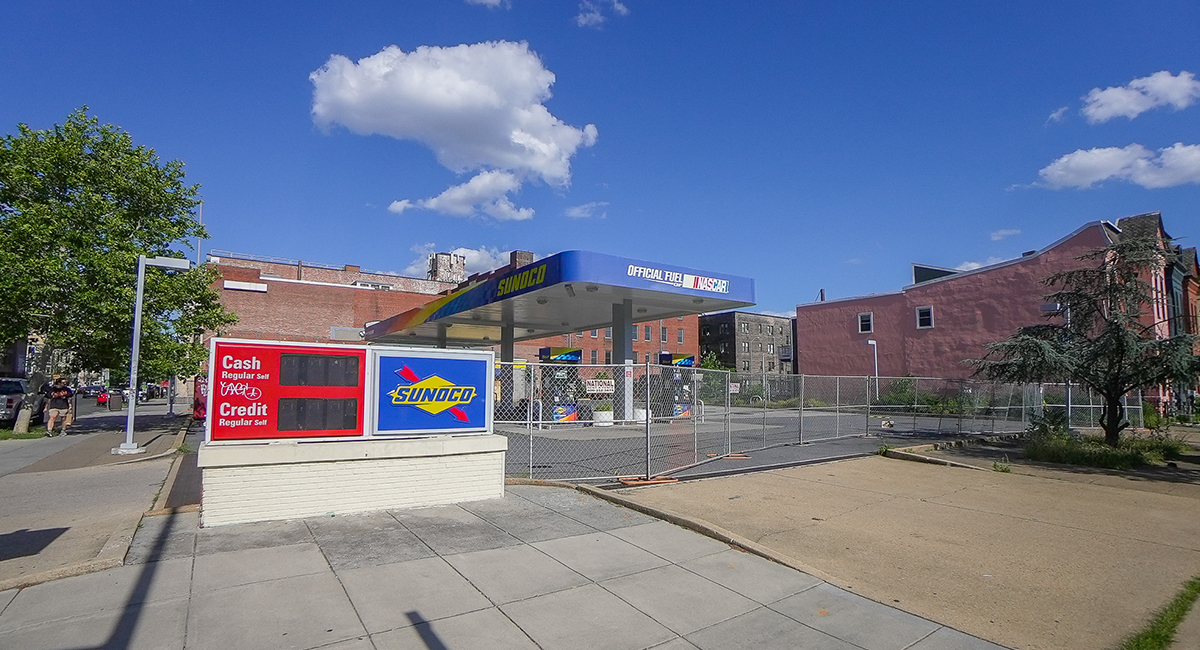
If it were 2019, Josh Feldman would have pitched his clients’ property on U Street to developers building multifamily apartments. The half-acre lot at the corner of 15th and U streets NW, home to a gas station for several decades, was already zoned for a high-rise, mixed-use apartment development.
But in 2026, as investors and developers flee D.C. to markets with more job growth and more business-friendly legislatures, Feldman knew the most efficient way to sell the property was to bring it to gas station operators. And he was right — Petroleum Marketing Group bought it for $7 million, saddling the neighborhood with a concrete slab in lieu of new apartments.
It’s a trend playing out across the city: Developments even in some of the hottest D.C. neighborhoods are being abandoned, sold, scaled down or deferred as investment money dries up. Permits to build housing last year were the lowest they’d been in 15 years, according to data from the U.S. Census Bureau. Groundbreakings across all sectors plunged 27% year over year, according to the Washington D.C. Economic Partnership’s annual development report.
In 2011, D.C. was rated No. 1 in the Urban Land Institute’s “markets to watch,” which rates cities for investment and development prospects. This year, it was ranked 49th.
Jair Lynch, a D.C. native who for decades rooted his real estate projects in the city, has drastically reduced his development projects in the District.
“In 2019, the majority of our development activity under construction was in the District,” he said. “By 2024, the total volume of our activity dropped by 80%.”
Some of the pressures are not unique to the District: Interest rates remain high, and inflation is driving up material costs. But D.C. also has a unique rap sheet that scares investors away, industry experts said. The District's high rent delinquency rate, weakened labor force, bureaucratic bottlenecks and unpredictable zoning processes make it hard for investors to see how or when they’ll make their money back.
“D.C. used to be viewed as one of the best markets in the country, and generally it floated above the fray,” said Feldman, the co-founder and managing principal of Feldman Ruel, a commercial real estate services firm. “It’s been one thing after another, and while this is an extremely resilient market, everything has a breaking point.”
Meanwhile, the city is gearing up for a new mayor who distanced herself from the business community during her primary campaign. Still, presumptive mayor Janeese Lewis George touted an ambitious housing production goal of building 72,000 new housing units within five years. But developers warn that without any meaningful policy changes, Lewis George will have a tough time reaching that objective.
In a social media post this week, Lewis George acknowledged that D.C. is “facing real economic challenges” and said she’d remove zoning rules that make it harder to build and would “address rent nonpayment while protecting tenants.” She also has a unique opportunity to make sweeping zoning changes as the city works through its latest draft of the Comprehensive Plan, a roadmap for how the city can and should develop.
Stunted Growth
Jodie McLean would love nothing more than to see 72,000 new housing units in D.C. The CEO of EDENS, the developer behind Union Market, wants to see the D.C. Council and the presumptive mayor succeed. But there’s a lot of work that needs to be done to get there, she said.
“Capital wants to follow where there’s growth,” she said.
Employment is one of those hurdles, and the District is still feeling the aftershocks of government-related layoffs. Since September 2020, D.C.’s unemployment rate has hovered above the national average, according to the U.S. Bureau of Labor Statistics. In August, the D.C. rate was 5.7%, while the national rate was 4.1%.
The city needs to find ways to attract businesses, said Aakash Thakkar, chief acquisitions officer at EYA, a residential real estate development firm. More industry means more jobs, taxpayers and spending circulating through the economy.
“If D.C. was San Francisco and had a booming industry like AI, and people were clamoring to live here … rents would move up … and the result of that would be capital would invest because they’d say, ‘Holy crap, look at the number of units that are needed for all these people breaking down D.C.’s door to be here,’” Thakkar said.
The D.C. Council is also considering a slew of new taxes that business leaders worry will deter companies from moving to the District and push a valuable tax base out of the city.
At a D.C. Council roundtable Friday, former mayor Anthony Williams testified that these taxes target “high earners and investors, professional services firms and their out-of-state owners, businesses and nonprofits with activity in the district, and owners of commercial property.”
“They already shoulder a disproportionate share of the city's tax burden,” he said. “They have a lot of options to relocate regionally and nationally. So in my mind, now is not the time to test out new tax regimes or layer on more taxes on the golden goose and hope for the best. We need every taxpayer here to stay. I ask you not to risk giving them a reason to leave.”
However, Gregory McCarthy, the chairman of the Board of Elections and former commissioner of the Tax Revision Commission, argued these taxes would help fund social services and make the city more affordable — both of which are draws for employees.
“ If you want to talk about why people are leaving, it’s because they can't afford to stay here,” he said. “So if I'm a business, and none of my employees can live within ten miles of my business, I might decamp to Virginia and go to Chantilly.”
Rent nonpayment is another hurdle: Tenant delinquencies in D.C. remain among the highest in the country. Mayor Muriel Bowser moved to address this issue in her sweeping 2025 RENTAL Act, which took effect this year. The bill rolled back emergency tenant eviction protections enacted during the pandemic. The mayor sent another bill to the D.C. Council this summer that would speed up eviction proceedings in court. But a dearth of judges causes logjams in the system.
Malcom Fox, the executive director of policy advocacy group Opportunity D.C., said delinquency and the city’s sluggish eviction process are the “elephant in the room” when it comes to convincing investors to come to D.C.
“That type of stuff doesn’t happen in Virginia,” he said.
“If you don’t address nonpayment of rent in a meaningful way, pretty much everything else is secondary, and it’ll maybe help a little bit at the margins,” Fox added. “The presumptive mayor will not be able to get anywhere near her promise of 72,000 units of new housing in the next five years without addressing that issue.”
Then there’s D.C.’s dizzying permitting process. Even in a good market, getting a project designed, approved and built takes years, Feldman said. In the meantime, developers have to cover their debt. In D.C., there are no clear deadlines for when the city must act on a building permit, Fox said, so projects “can languish for months and years.”
“The longer it stretches on, the harder the financing, and at some point it just becomes not viable,” Fox said. “You have to price in uncertainty.”
Stiffer Competition
Raising capital has gotten more competitive. Twenty years ago, real estate was a local business in D.C., industry experts said. Now it’s international, with investors coming from Europe and Asia. That means they’re not as loyal to cities as they were in the old days, and have shorter attention spans. Investors now jump from one city to the next when they notice a shinier developing region elsewhere. Cities in North Carolina, Tennessee and Texas are among those burgeoning markets.
“[Investors] don’t think that the [D.C.] government’s policies are pro-growth enough to warrant that investment,” Thakkar said.
McLean said EDENS is developing in other parts of the country “where you’re able to make those economics work.”
Rent growth in D.C. has been flat to down, and that, combined with inflated construction costs, makes it harder for developers to make up the difference, she said.
Even neighborhoods like Union Market, which McLean said had 5 million visitors last year (not including residents), have had to pivot as investment leaves the city. In August, JBG Smith stepped away from a mixed-use development project with Gallaudet University.
For years, EDENS has had big plans for the corner of Penn and 4th Street NE, the former home to a Motel 6: a two-building, 350-unit residential development with 30,000 square feet of retail.
But last month, the developer announced a different plan for the space: a 30-room hotel called Late Checkout, along with a cocktail bar and outdoor patio. McLean said she is excited about the project and that the company noticed a demand for a hotel and amenity like this in the neighborhood.
“This is what makes the most sense there,” McLean said. “And the long-term vision — 10 years out — can it have a different iteration to it? Perhaps, yes.”
Still, these developers are hopeful that things will turn around in D.C.
“I do think the people who have stuck around will be rewarded,” Feldman said. “And frankly that's what historically has almost always happened if you're patient enough.”
Feldman looks at it as the usual boom and bust cycle of a real estate market. While he acknowledges this is “an elongated downturn,” and that it may be up to three years before any meaningful improvement in the market, he is still bullish about D.C.’s future.
“There are still some good returns to be gotten,” he said. “This is the best buyer’s market that I’ve seen in D.C. in my entire career.”